



Spanish partners of the Extreme Light Infrastructure gather at IMDEA Nanociencia
11.11.2026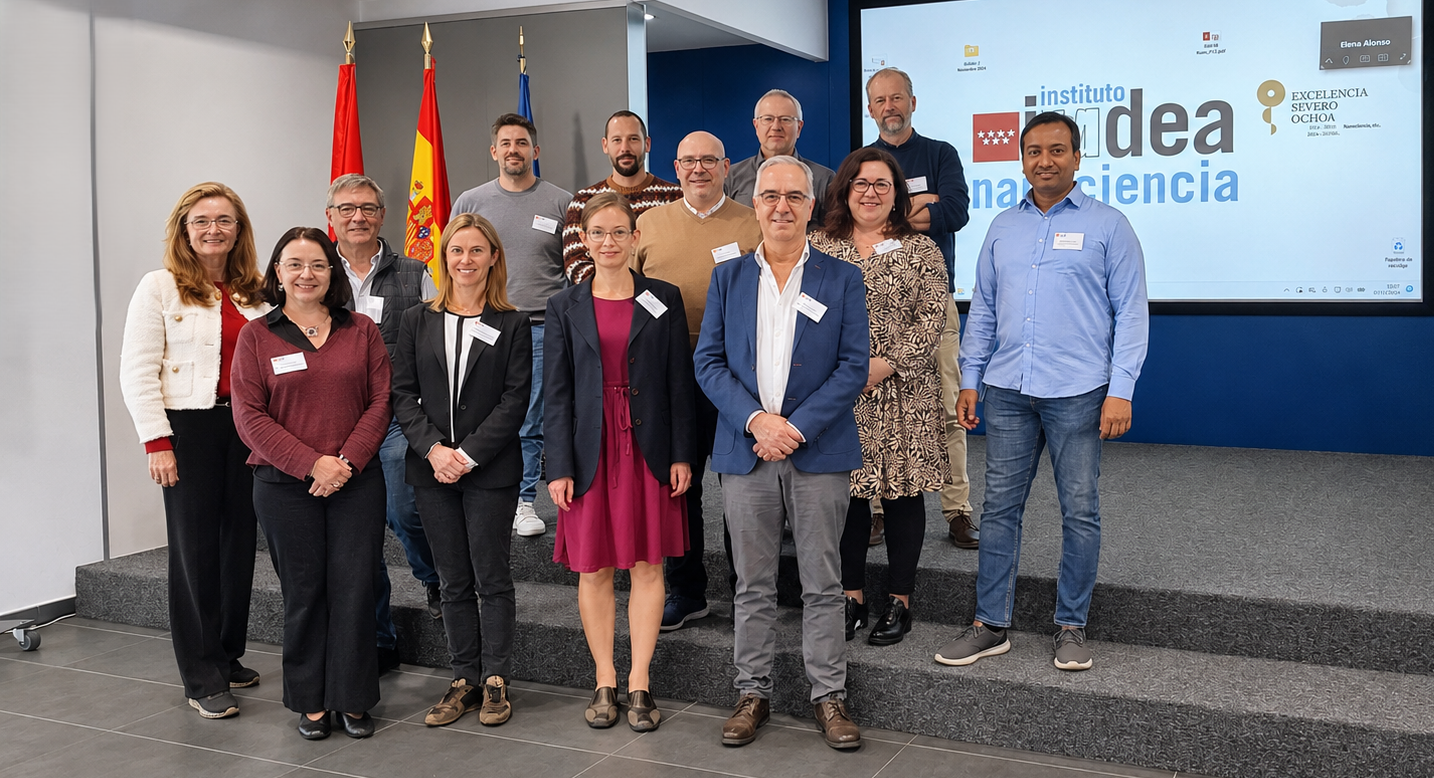
- On the 3rd of November, the leading collaborators of the Extreme Light Infrastructure (ELI) gathered at IMDEA Nanociencia.
- During the meeting, the priorities of the Spanish scientific community were discussed.
| Tweet |  |
Press release download |
Madrid, 11th November, 2026. The ELI Workshop was attended by Spanish collaborators, users and representatives of the Extreme Light Infrastructure (ELI). ELI is the world’s largest and most advanced high-power laser platform, and operates as a European Research Infrastructure Consortium (ERIC). Dr. Enrique Cánovas was the host of the event at IMDEA Nanociencia.
During the morning session, Zsolt Fülöp, Naďa Witzanyová, and Luca Volpe presented on the institutional and user management aspects of ELI-ERIC. This was followed by a presentation on the research priorities and interests of the Spanish scientific community, with presentations by representatives from GELUR-RSEF (Crina Cojocaru), CLPU (Giancarlo Gatti), IMDEA Nanociencia (Enrique Canóvas), and the Guillermo Velarde Institute of Nuclear Fusion (Pedro Velarde).
In the afternoon, the experimental capabilities of the ELI ALPS and ELI Beamlines facilities were detailed in presentations by Subhendu Kahaly and Eva Klimešová. In addition, María Teresa Flores (University of Santiago de Compostela) and Luis Bañares (Complutense University of Madrid) presented the research areas of their respective universities related to ELI.
ELI is the first ESFRI flagship facility built in the Member States of Central and Eastern Europe. With an investment of more than 850 million euros from the European Regional Development Fund, three world-class high-power, high-repetition-rate laser facilities have been established in the Czech Republic (ELI Beamlines), Hungary (ELI-ALPS), and Romania (ELI-NP).
In terms of research, ELI’s lasers open up a wide range of possibilities for discovery, from fundamental research in strong-field physics to highly practical problems in materials science and engineering. The techniques deployed at ELI enable pulse durations down to the attosecond timescale and peak power in the tens of petawatts, opening new horizons for “big science” in key scientific disciplines such as physics, biology, and materials science, with a uniquely cost-effective approach.
Related information:
Contact:
Dr. Enrique Cánovas
This email address is being protected from spambots. You need JavaScript enabled to view it.
Nanostructured Photovoltaics Group
https://nanociencia.imdea.org/nanostructured-photovoltaics/group-home
IMDEA Nanociencia Dissemination and Communication Office
divulgacion.nanociencia [at]imdea.org


Source: IMDEA Nanociencia.
IMDEA Nanociencia Institute is an interdisciplinary research Centre in Madrid (Spain) dedicated to the exploration of nanoscience and the development of applications of nanotechnology in connection with innovative industries.